
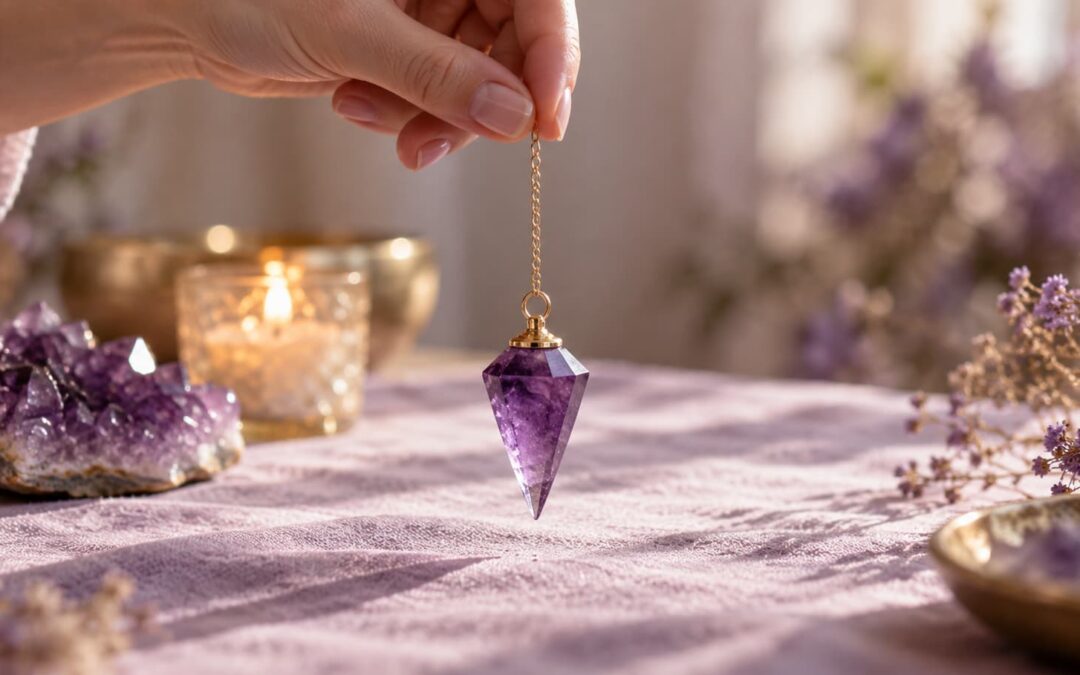
Using a pendulum begins with a few simple steps: choose one that feels comfortable, hold its chain gently, establish how you’ll interpret its movements, and ask clear questions. From there, you can explore the practice at your own pace.
People use pendulums for spiritual reflection, intuitive exploration, and energy work. Some understand the movement as a connection with universal energy; others approach it as a way to notice their own expectations and subconscious responses. This guide covers choosing, preparing, and working with a pendulum, along with chakra practices, advanced exercises, and common difficulties.
- Choose a pendulum you enjoy holding. Its comfort and personal meaning matter more than its price.
- Cleansing and intention-setting are optional spiritual rituals that can help you prepare for a session.
- Establish your own movement patterns for yes, no, undetermined, and not answering.
- Begin with simple questions and keep a record of what happens, including unclear or incorrect responses.
- Use pendulum work for personal exploration while checking important decisions against facts and your own judgment.
Understanding the Power of the Pendulum
A pendulum is a small weight suspended from a chain or cord. In divination, the person holding it observes its swings and rotations and assigns meaning to those movements. The practice is associated with dowsing, which has also been used in attempts to locate water and hidden objects.
For spiritual practitioners, working with a pendulum can be a way to slow down, focus attention, and explore questions about personal choices or spiritual growth. Some describe it as connecting with intuitive wisdom or unseen energy. These are spiritual interpretations rather than established explanations of how the object moves.
There’s also a physical explanation worth understanding. Small movements of your fingers and arm can produce much larger pendulum swings without you feeling that you’re deliberately moving it. Research on the Chevreul pendulum effect has recorded this process. It helps explain why a pendulum can appear to move on its own.
Water divination has a long history, but its history doesn’t establish its reliability. The U.S. Geological Survey’s explanation of water dowsing describes why apparent successes can occur and why locating useful groundwater requires geological investigation.
You can still approach a pendulum as a meaningful spiritual tool. Keeping its limitations in mind gives you room to explore the experience without treating every movement as proof of hidden knowledge.
Choosing the Right Pendulum
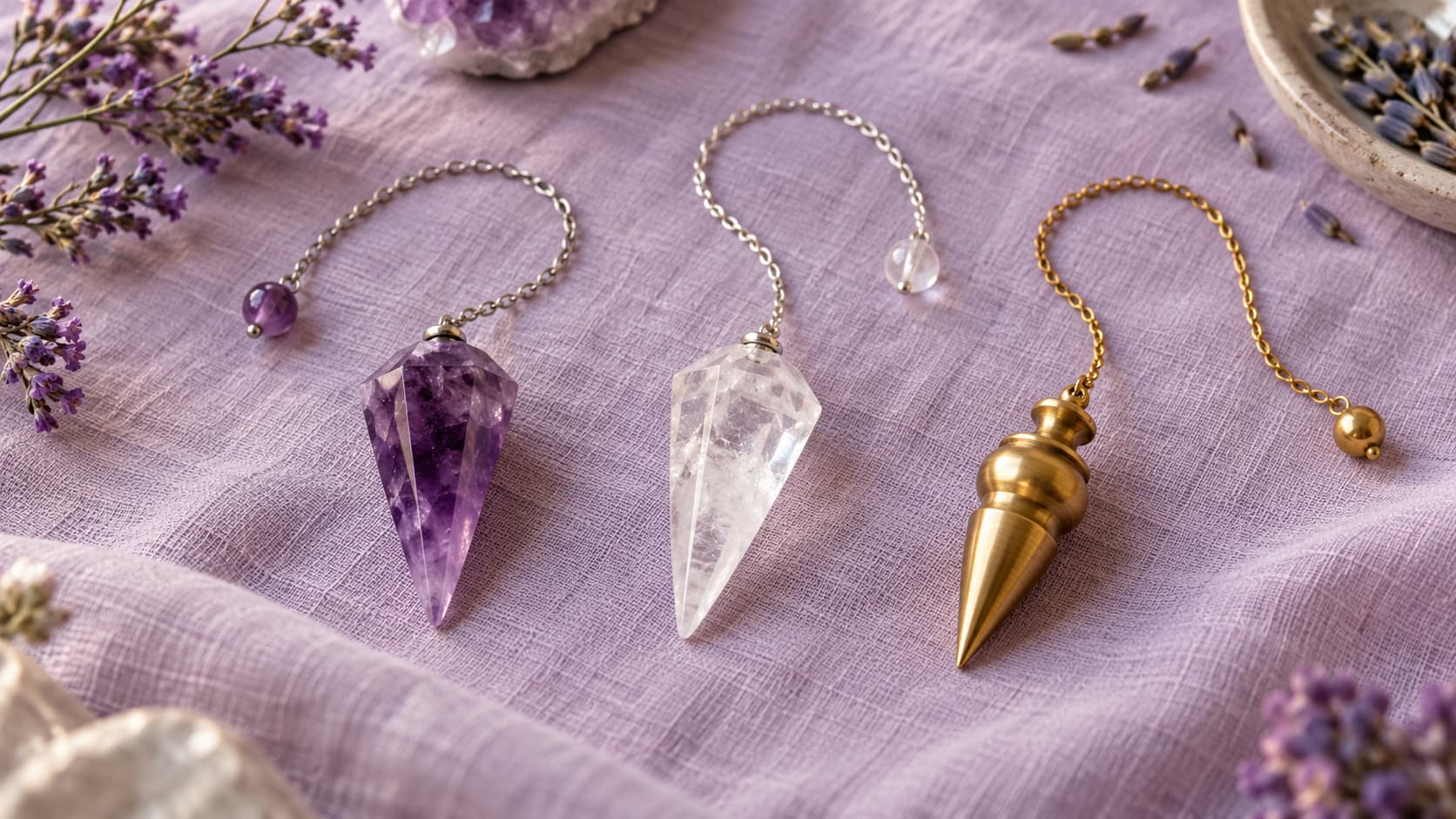
Start with a pendulum that feels comfortable in your hand and appeals to you. There are several materials to choose from, each with its own appearance, weight, and spiritual associations.
| Material | Qualities and Spiritual Associations |
|---|---|
| Crystal | Clear quartz and amethyst are popular choices. In crystal traditions, they’re associated with clarity, intuition, and spiritual connection. Their shapes and natural markings vary. |
| Metal | Brass and copper pendulums often have a substantial feel. Practitioners may associate them with stability and balanced energy, though the material doesn’t guarantee accurate answers. |
| Wood | Wooden pendulums are often lighter. Their natural appearance appeals to people who connect with grounding practices and earth symbolism. |
Crystal pendulums are popular, but you don’t need to choose one simply because someone else recommends it. Notice how you respond when you look at or hold a particular piece. You might feel drawn to one, while another looks beautiful but leaves you feeling no connection.
Some practitioners describe this as the pendulum choosing you. You may experience it as a sense of warmth, interest, or personal connection. Take your time and trust your preference without feeling that you have to experience a dramatic sensation.
Check the practical details, too: the chain should be secure, the grip comfortable, and the weight able to hang freely. If you enjoy exploring the symbolism of different stones, browse the crystal articles for more ideas.
Preparing Your Pendulum for Use
Many practitioners prepare their pendulum by cleansing it, setting an intention, and spending quiet time with it. Within spiritual practice, these steps are often described as clearing old energy and forming a connection. You can use them as a personal ritual rather than a requirement for making the pendulum work.
Cleansing the Pendulum
Choose a method that suits your beliefs and the material your pendulum is made from. Common approaches include:
- Cleansing smoke: Some people pass a pendulum through incense or herbal smoke while imagining unwanted energy clearing away. If you use smoke, ventilate the room and keep the pendulum away from the flame.
- Sea salt: Placing a pendulum in salt overnight is a traditional option, but direct salt contact isn’t suitable for every stone or metal. Keeping the pendulum beside a separate bowl of salt offers a symbolic alternative.
- Spring or filtered water: Water is sometimes used to symbolize washing away lingering energy. Only rinse a pendulum if its stone, metal fittings, and construction are suitable for water.
- Selenite: Some practitioners place their pendulum near a selenite bar or lamp as a cleansing and charging ritual. This offers an option without direct salt or water contact.
If you’re unsure how to care for the material, choose a dry method and follow the seller’s care instructions. A visualization is also a simple way to mark the beginning of your session.
Programming the Pendulum
“Programming” usually means setting your intention and deciding how you’ll approach the practice. It can help you settle your attention, though it doesn’t establish that the answers will be accurate.
- Choose a quiet spot where you won’t be interrupted.
- Hold the pendulum in your dominant hand, or whichever hand feels more comfortable.
- Take a few slow breaths. If visualization is part of your practice, imagine a gentle white light around it.
- State your intention clearly, aloud or silently.
- Repeat the intention if it helps you feel focused and ready.
A traditional intention from this practice is:
“I set this pendulum to give truthful, clear and accurate answers that are in my highest and greatest good.”
Treat those words as an expression of what you hope to bring to the session, rather than a guarantee of truthful answers.
Charging the Pendulum with Your Energy
To try a charging visualization, hold the pendulum close to your heart. Close your eyes if you feel comfortable, breathe slowly, and imagine a warm ball of positive energy in your chest. Picture it moving down your arms toward the pendulum, like a gentle connection between your heart and the object.
You might focus on love, gratitude, or a wish to approach your questions honestly. The aim is to make time for a calm, intentional beginning.
Some people like to keep their pendulum nearby at night or hold it briefly before bed. You can place it safely on your bedside table afterward. There’s no need to sleep with a pointed object or chain under your pillow to develop a personal connection with it.
Basic Techniques for Using a Pendulum
Once you’ve chosen and prepared your pendulum, begin with short sessions. Give yourself time to become familiar with its weight, the length of the chain, and the movements you observe.
Holding the Pendulum
Find a quiet place to sit. Gently hold the end of the chain, cord, or fob between your thumb and index finger, leaving the weighted end hanging freely. Keep your grip secure without squeezing, and relax your shoulder.
Resting your elbow or forearm on a table or chair arm may make the position more comfortable. Leave enough space below the pendulum for it to move without touching your hand or another surface. Supporting your arm won’t remove every small movement, so don’t assume it makes a response independent of you.

Calibrating Your Pendulum
In pendulum practice, calibration means establishing how you’ll interpret different movements. You might observe clockwise circles, counterclockwise circles, side-to-side swings, forward-and-back swings, or stillness.
- Ask for “yes.” Let the pendulum settle, then ask it to show a yes response. Observe and record the movement.
- Ask for “no.” Pause and repeat the process for a no response.
- Ask for “undetermined.” This can represent uncertainty or no clear answer within your practice.
- Ask for “not answering.” You might assign a distinct movement or stillness to a response you’ll leave uninterpreted.
Some spiritual interpretations understand “not answering” as a prompt to work through a life lesson yourself. For example, a recurring situation may invite you to consider trust, boundaries, or your own intuition. That can be a useful reflection, but an unclear swing doesn’t establish why an answer is absent.
Write down your response patterns. Calibration gives you a consistent framework for the exercise; it doesn’t prove that the pendulum can reveal unknown facts.
Formulating Clear Questions
Ask one question at a time, with wording you can interpret plainly. Questions that combine several issues make it harder to understand what a response might mean.
Begin with statements whose answers you already know, such as “Is today Tuesday?” or “Is my birthday in March?” Include both true and false statements so you can observe both response patterns.
The original exercise contrasts “Will the future bring happiness?” with “Will I find happiness within the next six months?” The second has a clearer time frame, but happiness is still subjective, and neither question can turn a pendulum into a reliable predictor. A grounded reflective question could be, “Would I like to make more time for activities I enjoy this week?” Follow that by considering what you can actually do.
Wording such as “Is it true that…” or “Should I…” is common in pendulum work. Keep the topic small, and remember that you remain responsible for deciding what to do.
Interpreting Responses
Compare what you observe with the patterns you recorded during calibration. Avoid deciding afterward that a different swing must mean the answer you were hoping for.
A circular swing isn’t universally yes, and an irregular swing isn’t universally no. If the response is weak, mixed, or changes direction, record it as unclear. You don’t have to force an interpretation.
Understanding Swing Directions
Different practitioners use different meanings for the same movement. Work with the framework you established rather than assuming there’s one standard language of swings and rotations.
Keep notes on the question, movement, interpretation, and anything you later verify. Your expectations can influence the experience, so include mistakes and uncertainty alongside results that seem meaningful.
Using the Pendulum for Chakra Reading
In chakra-based spiritual practices, a pendulum is sometimes used to explore the seven main energy centers. Practitioners may interpret its movement as a symbolic picture of balance, openness, or areas for reflection. This is a spiritual exercise, not a way to measure physical health or diagnose a condition.
To explore the practice, choose a peaceful space and work from the root chakra upward toward the crown. You can use a labeled chakra diagram laid flat on a table, especially if reaching different areas of your own body would make your posture awkward.
Hold the pendulum above each position without touching it, observe the movement, and record what happens. Some traditions associate smooth circular movement with flow and weak or erratic movement with an area needing attention. These interpretations vary, and movement alone can’t establish that a chakra is blocked.
| Chakra | Traditional Interpretation and Reflection |
|---|---|
| Root | Steady or circular movement may be interpreted as grounding. Weak or erratic movement may prompt reflection on stability, security, and feeling supported. |
| Sacral | Fluid movement may symbolize emotional ease and creativity. Stiff or irregular swings may invite reflection on emotional expression or creative stagnation. |
| Solar Plexus | A steady swing may symbolize confidence. Inconsistent movement may prompt questions about personal agency, self-belief, and empowerment. |
| Heart | Gentle, flowing swings may be interpreted as openness. Restricted or jerky movement may become a prompt to reflect on grief, compassion, or expressing love. |
| Throat | Consistent movement may symbolize ease in communication. Hesitant movement may prompt reflection on speaking honestly and feeling heard. |
| Third Eye | Harmonious movement may symbolize intuitive clarity. Stillness or an unsteady swing may invite reflection on discernment, attention, and inner perspective. |
| Crown | Gentle or expansive movement may symbolize spiritual connection. Limited or irregular movement may prompt reflection on meaning, belonging, and spiritual exploration. |
These are brief examples rather than a universal interpretation guide. Learning more about chakra traditions, speaking with an experienced practitioner, or studying Reiki may add context to the spiritual practice. Any symptoms or health concerns need an appropriate healthcare assessment.
If this topic interests you, you can also learn about Daniela’s chakra cleansing sessions.
Advanced Pendulum Techniques
Once you’re comfortable holding the pendulum and recording responses, you may want to explore other exercises. Keep them playful and reflective, and check any factual result independently.
1. Finding Lost Objects
Some practitioners use a pendulum when searching for misplaced keys or jewelry. They ask a question such as “Are my keys in the living room?” and use the response to choose where to look next.
You can try this as an experiment alongside retracing your steps and checking likely places. Record unsuccessful suggestions as well as apparent successes. Finding an item after a session doesn’t by itself show that the pendulum located it.
2. Using a Pendulum Map
A pendulum map or chart divides a page into labeled areas. These might contain yes/no responses, possible activities, or topics for reflection. Hold the pendulum above a central point and observe which way it swings.
Keep the labels clear and avoid packing too many choices into the chart. If it points toward “rest,” for example, use that as a prompt to ask how tired you feel and what your schedule allows. The chart can start a reflection without making the decision for you.
3. Pendulum in Healing Work
Within some energy-healing traditions, practitioners hold a pendulum above different body areas and interpret smooth or circular swings as balance, with irregular movements interpreted as imbalance. They may combine this with meditation, visualization, or Reiki.
These interpretations belong to the spiritual framework of the practice. A pendulum can’t establish a medical diagnosis, confirm a treatment is working, or determine that an illness has been healed. If you include it in a wellbeing ritual, keep its role focused on relaxation and personal reflection.
Common Challenges and Troubleshooting
Mixed responses and uncertain movements are common reasons people feel stuck. Instead of pushing for an answer, look at the question, your position, and what you’re expecting from the session.
Inconsistent Responses
If answers keep changing, pause. Check whether you’ve changed the wording, altered your grip, or begun anticipating a particular response. Feeling tired, tense, or strongly invested in an outcome can also make a session harder to approach calmly.
Return to a simple known-answer exercise if you want to continue. If the movements remain unclear, write that down and finish for the day. Repeatedly asking until you get a preferred answer won’t make the result more trustworthy.
Environmental Factors Affecting Pendulum Behavior
Give the pendulum room to hang freely. Check for drafts, a moving table, a chain catching on your fingers, or the weight brushing your palm. Try a comfortable seated position with your arm supported.
Putting your phone aside may reduce distractions. Claims that ordinary phones or computers routinely disrupt a pendulum through electromagnetic fields aren’t established here, so there’s no need to assume an electronic device is responsible for an unclear response.
Maintaining a Clear Mind and Objective Perspective
Before you begin, notice what answer you want to receive. Being aware of that preference can help you recognize when you’re reading too much into an uncertain movement.
Write the exact question before asking it, keep your interpretation consistent, and allow “I don’t know” to be a complete outcome. A clear mind can make reflection easier, but it doesn’t remove every influence of expectation or unconscious movement.
If you find yourself asking the same question repeatedly or feeling unable to act without a pendulum response, put it down. Take a break, consider the available facts, and return to your own judgment.
Conclusion
Learning to use a pendulum involves more than memorizing swing directions. Choosing one you enjoy, preparing thoughtfully, asking clear questions, and noticing your own expectations all shape the experience.
You may find that it becomes a meaningful part of your spiritual routine. Let it create space for curiosity and self-reflection while keeping your decisions grounded in what you can observe, check, and choose for yourself.
Practice with Your Pendulum
Try these activities over several short sessions. There’s no need to cover everything at once.
- Cleansing and charging: Choose a preparation ritual suited to your pendulum’s material. Try a heart-centered visualization and note how settled you feel before and afterward.
- Calibration exercises: Record the movements you associate with yes, no, undetermined, and not answering. Notice whether the patterns remain consistent between sessions.
- Question practice: Use a mixture of simple true and false statements with known answers. Record every result, then practice making vague reflective questions more specific.
- Chakra reflection: Work through a chakra diagram from root to crown. Use the traditional themes as journaling prompts rather than conclusions about your health.
- Advanced techniques: Try a simple pendulum chart or a small lost-object experiment. Compare your interpretation with what you can independently verify.
A notebook can make this more useful. Record the date, question, movement, interpretation, and any later observation. Over time, you’ll have a clearer picture of your experience, including its limits.
For more spiritual practices and perspectives, explore the divination articles.
Sources and Original Reading Resources
The research links below support the discussion of movement and water dowsing. The original article’s spiritual reading resources are also retained for readers who want to explore those perspectives.
- Cantergi, Awasthi, and Friedman: research on the Chevreul pendulum effect — Human Movement Science, 2021.
- U.S. Geological Survey: Water Dowsing.
- Moonhaus: The Art of Pendulums — original reading resource.
- Human Parts: The Art of Penduluming — original reading resource.
- Alicja Jones: Mastering the Art of Pendulum Divination — original reading resource.
Further Reading
Fancy reading a little more? Choose a topic below to find more articles, reflections and ideas from the blog.
Explore a Private Session with Daniela
If you'd like to explore your own questions or spiritual interests, Daniela offers private online sessions. Take a look below and see what feels right for you.

Psychic Readings
Talk through the questions on your mind, reflect on recurring patterns and explore possibilities with Daniela's intuitive guidance.
Explore Psychic Readings
Mediumship Readings
A compassionate space to explore spiritual connection and messages Daniela may receive from loved ones who have passed.
Explore Mediumship
Chakra Cleansing
Make time for a spiritual energy session focused on the chakras, personal reflection and a sense of balance.
Explore Chakra CleansingPrivate online sessions with Daniela DeCastro. Spiritual experiences are personal, and individual experiences vary.